
Do I Have to Buy 4 New Tires for 4WD?
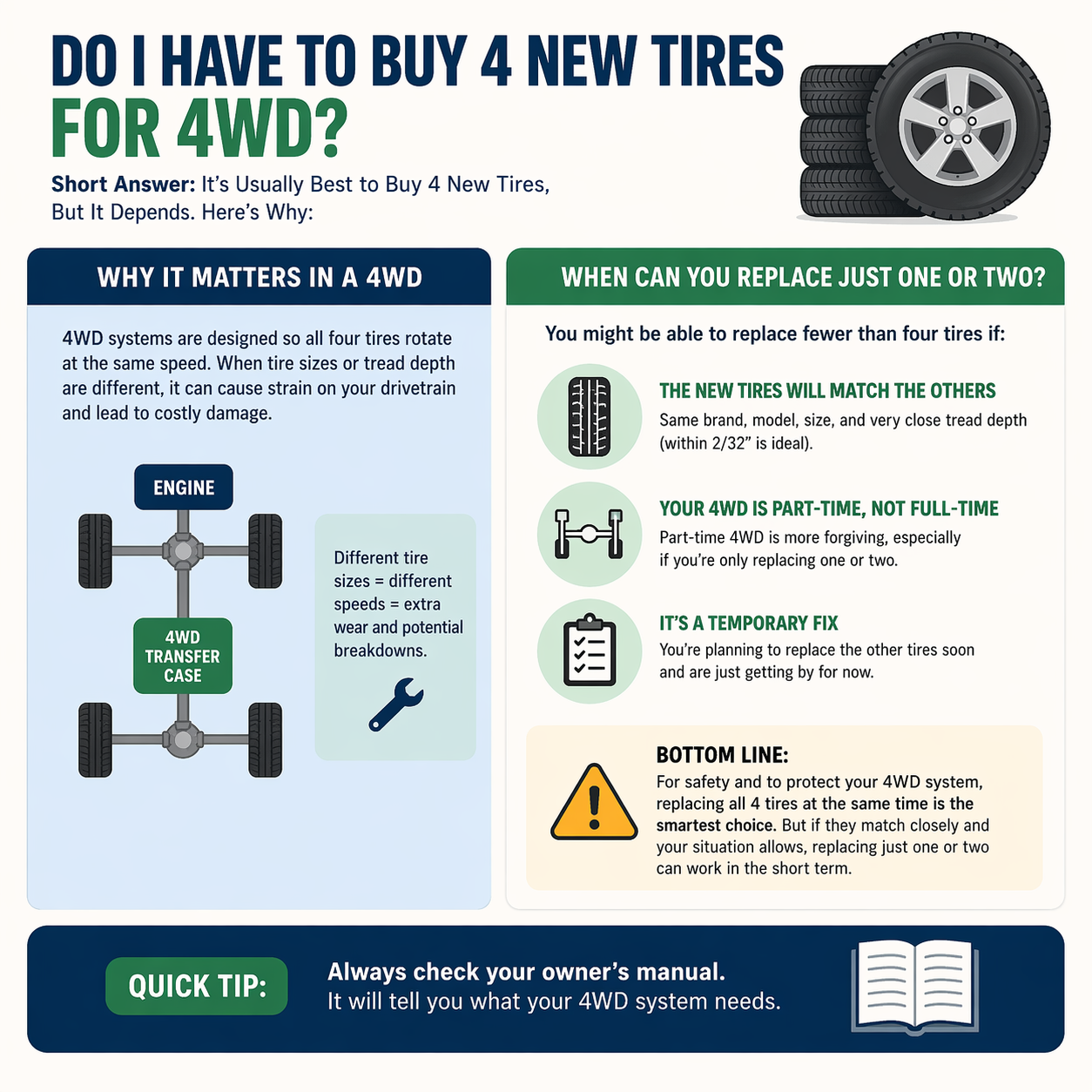
If you drive a 4WD or AWD vehicle, tire replacement isn’t just about tread; it’s about protecting your drivetrain. One wrong decision can lead to expensive repairs to components such as the transfer case, differentials, and driveshafts. So when one tire goes bad, the question that arises is usually:
Do you really need to replace all four tires?
The short answer: Sometimes yes, and sometimes no. But the details matter, and getting this wrong can cost you far more than a set of tires. A trusted tire shop can always point you in the right direction.
Why 4WD Systems Are Sensitive to Tire Differences
Unlike 2WD vehicles, 4WD and AWD systems distribute power to all four wheels. That means all tires must rotate at nearly identical speeds.
When tires have different diameters (even slightly), it creates a mismatch in rotational speed. The drivetrain tries to compensate, which leads to:
- Excessive wear on differentials
- Strain on the transfer case
- Heat buildup in drivetrain components
- Premature failure of expensive parts
Even a difference of 2/32 inch to 4/32 inch in tread depth can be enough to cause problems, depending on the vehicle.
When You DO Need to Buy All 4 Tires
In many real-world scenarios, replacing all four tires is the safest (and sometimes the only) option.
1. Significant Tread Wear Difference
If your existing tires are worn down and one fails, installing a brand-new tire creates a diameter mismatch.
- New tire tread: ~10/32 inch
- Worn tires: ~4/32″-6/32 inch
That gap is too large for most 4WD systems to tolerate.
Result: Replace all four tires.
2. Manufacturer Requirements
Many automakers explicitly recommend replacing all four tires on AWD/4WD vehicles. This is especially true for:
- Subaru AWD systems
- Audi Quattro
- Some Toyota and Honda AWD setups
Ignoring these recommendations can void warranties or lead to drivetrain damage.
3. Uneven Wear Across Tires
If your tires have worn unevenly due to alignment issues or skipped tire rotation, even replacing two tires may not solve the problem.
Result: Full set replacement ensures balance and prevents future issues.
4. Performance and Safety Concerns
Mixing tires with different tread depths impacts:
- Traction (especially in wet conditions)
- Stability during braking
- Handling consistency
For SUVs and trucks running SUV tires, this becomes even more important due to the higher center of gravity and load demands.
When You MAY NOT Need All 4 Tires
There are situations where replacing fewer than four tires is acceptable, but they’re limited.
1. Minimal Tread Difference
If your existing tires are relatively new (within ~2/32 inch tread difference), you may be able to replace just one tire safely.
This is rare but possible with low-mileage sets.
2. Tire Shaving (Advanced Option)
Some tire shop locations offer tire shaving, machining a new tire down to match the tread depth of the others.
- Maintains equal diameter
- Protects drivetrain
- Saves money vs. buying four tires
However, not all shops offer this service, and it’s typically used for higher-end or performance vehicles.
3. Replacing Tires in Pairs (Conditional)
In some part-time 4WD systems (not full-time AWD), replacing two tires may be acceptable if:
- The new tires are installed on the same axle.
- The tread difference is within acceptable limits.
But this depends heavily on the specific drivetrain design. When in doubt, assume four tires are required unless a technician confirms otherwise.
The Hidden Cost of Doing It Wrong
Trying to save money by replacing just one tire can backfire fast. Typical drivetrain repair costs:
- Transfer case repair: $1,500-$3,500+
- Differential replacement: $1,000-$2,500+
- Driveshaft damage: $500-$1,500+
Compare that to a full set of tires, and the decision becomes clear.
How Tire Rotation Prevents This Problem
Regular tire rotation is the simplest way to avoid needing four new tires at once. By rotating tires every 5,000-7,000 miles, you ensure:
- Even tread wear across all four tires
- Longer overall tire lifespan
- Greater flexibility if one tire needs replacement
Skipping rotations is one of the main reasons drivers end up needing to buy a full set early.
What McClary Tire Recommends
At McClary Tire, our approach is straightforward: Protect the vehicle first, and optimize cost second. When evaluating your 4WD tire replacement, a technician will check:
- Current tread depth across all tires
- Manufacturer specifications
- Drivetrain type (full-time AWD vs part-time 4WD)
- Wear patterns from alignment or suspension issues
From there, you’ll get a clear recommendation, whether that’s:
- Replacing all four tires
- Matching tread depth with a shaved tire
- Replacing two tires (when safe and appropriate)
Final Answer: Do You Have to Buy 4 New Tires for 4WD?
In most cases, yes, especially if your current tires are worn.
Trying to cut corners here can lead to far more expensive problems than a full set of tires. The safest move is to have your tires inspected by a qualified tire shop that understands 4WD systems and can give you a precise recommendation.