
Dealership vs. Independent Shop Oil Change Costs: Which Is Cheaper and Where Should You Go?
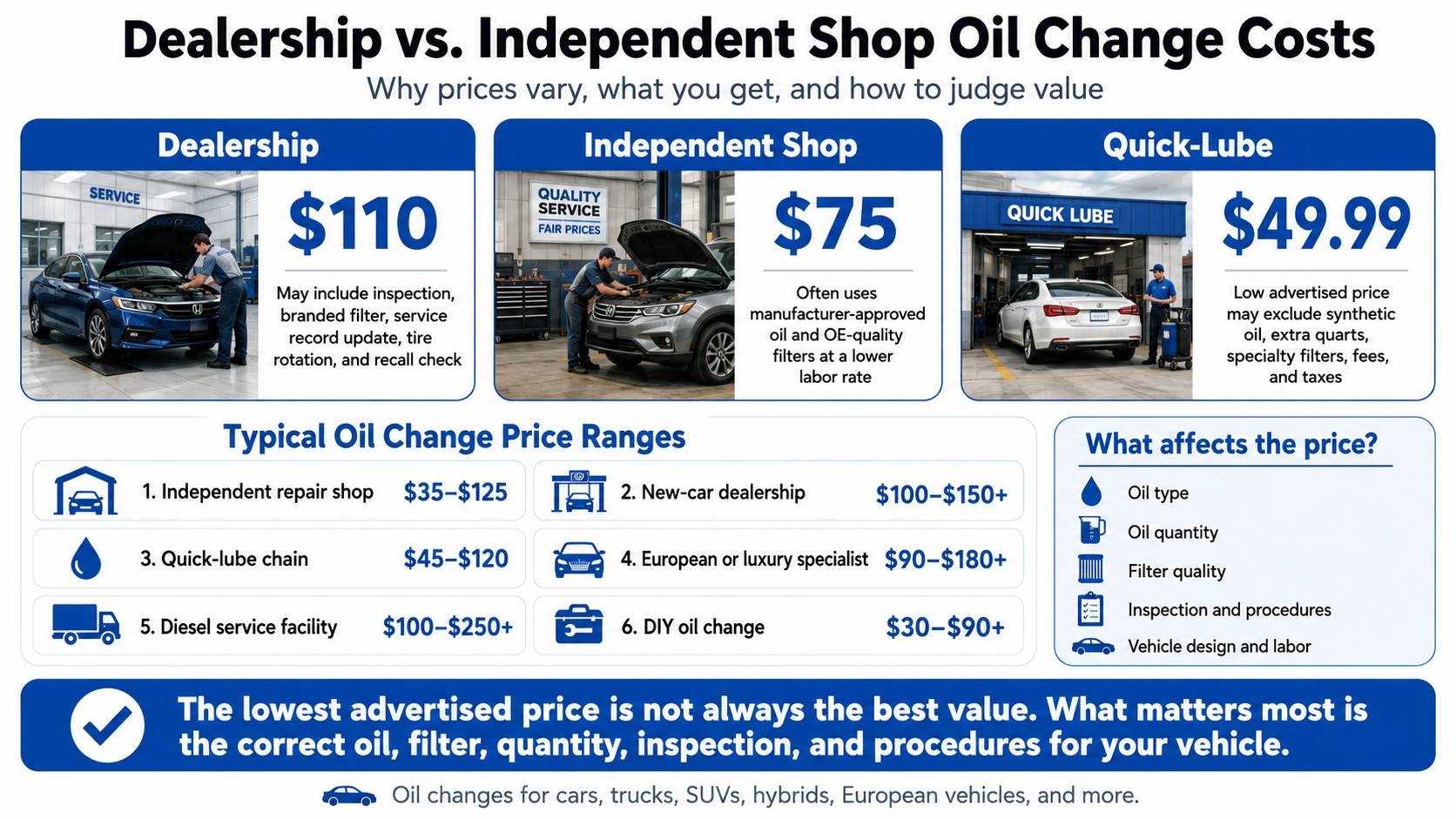
Oil change prices can vary significantly depending on location. A dealership may charge $110, an independent shop charges $75, and a quick-lube chain may advertise $49.99. But, those prices may cover very different services.
McClary Tire provides professional oil changes in Athens and Decatur, AL, for cars, trucks, SUVs, hybrids, European vehicles, and other applications. Its technicians replace the oil and filter, inspect key fluids and components, and can address additional maintenance needs during the same visit.
Dealership vs. Independent Oil Change Costs at a Glance
Oil-change prices vary by location, vehicle, oil specification, capacity, and current promotions. The following estimates provide a practical starting point.
| Service provider | Typical oil-change cost | What commonly affects the price |
| Independent repair shop | Approximately $35-$125 for most conventional or synthetic services | Oil type, quantity, filter, inspection, labor, vehicle design |
| New-car dealership | Often around $100; specialty applications may exceed $150 | Factory oil and filter, brand-specific procedures, higher labor rates, included inspections |
| Quick-lube chain | Approximately $45-$120 before vehicle-specific additions | Synthetic upgrade, extra quarts, specialty filter, shop fees |
| European or luxury specialist | Approximately $90-$180+ | Manufacturer-approved oil, larger capacity, cartridge filter, underbody access |
| Diesel service facility | Approximately $100-$250+ | High oil capacity, diesel-rated oil, large filters, additional labor |
| DIY oil change | Approximately $30-$90+ after tools are purchased | Oil, filter, seal, disposal, capacity, product quality |
Kelley Blue Book currently approximates a conventional oil-and-filter change to cost between $35 to $75 and a synthetic service between $65 to $125. A separate 2026 pricing guide estimates that dealership oil changes average around $100, although individual quotes can be substantially lower or higher.
Are Dealership Oil Changes More Expensive?
Dealerships usually have higher labor rates and operating costs than independent repair shops due to factory training, specialized equipment, manufacturer systems, support staff, warranty administration, and larger facilities. AAA reports that dealership labor can cost 25% or more than independent repair labor.
However, the difference may be smaller for an oil change because dealerships often offer discount routine maintenance to bring customers into the service department. Specials may include manufacturer coupons, prepaid maintenance, tire-rotation packages, loyalty discounts, or complimentary first services.
As a result, the advertised dealership price may be competitive. The final cost depends on whether the offer includes the correct oil specification, full oil capacity, required filter, and any additional fees.
Are Independent Shop Oil Changes Cheaper?
Independent shops are frequently less expensive because their overhead structure and parts options differ from those of franchised dealerships.
A qualified independent shop may use:
- Manufacturer-approved motor oil
- API-certified oil
- Original-equipment-supplier filters
- Premium aftermarket filters
- Bulk oil purchased at a lower cost
- Vehicle-specific maintenance information
- Professional diagnostic and inspection equipment
The shop can often choose among several compliant products instead of relying primarily on manufacturer-branded packaging.
A manufacturer-branded oil filter may have been produced by an outside supplier. An independent shop may be able to purchase a suitable product from that supplier or another reputable filter manufacturer at a lower cost.
The independent shop’s advantage is not simply access to cheaper parts. It is the ability to choose an appropriate balance of quality, cost, and warranty for the customer’s vehicle.
McClary Tire’s preventive maintenance service is based on manufacturer recommendations and vehicle use, rather than a single universal maintenance plan. Services include oil and filter replacement, fluid checks, filters, belts, brakes, batteries, tire maintenance, and scheduled inspections.
Dealership Advantages
A dealership may be the best place for an oil change in several situations.
Your Oil Changes Are Included
Some new vehicles include complimentary maintenance for a specified time or mileage.
The plan may cover:
- Oil and filter changes
- Tire rotations
- Inspections
- Fluid checks
- Other scheduled services
Using the included maintenance is usually the lowest-cost option because the service is already built into the vehicle purchase or ownership program.
Review the limits carefully. The plan may cover only the oil-life-monitor interval, exclude severe-service intervals, or terminate after a specific date, even when the mileage remains low.
You Purchased a Prepaid Maintenance Plan
A dealership may sell a package covering several future services.
If you have already paid for the plan, use it unless the contract creates a strong reason not to.
Confirm:
- Which dealerships accept it
- Which services are included
- Whether synthetic oil is covered
- Whether extra quarts are included
- Whether tire rotations are included
- When the plan expires
- Whether the plan transfers with the vehicle
A prepaid plan is different from the vehicle’s factory warranty.
The Vehicle Has an Open Recall
A dealership can complete manufacturer recall work while the vehicle is present for maintenance.
An independent shop may identify or notify you of a recall, but the manufacturer-funded recall repair must usually be completed through an authorized dealer.
You Have an Unresolved Warranty Concern
Suppose a nearly new vehicle is losing oil between changes, leaking from a gasket, producing timing-chain noise, or displaying a low-oil-pressure warning.
Taking it to the dealer may simplify the warranty claim because the dealer can inspect the condition, document the oil level, communicate with the manufacturer, and complete an approved repair.
An independent shop can provide an inspection or second opinion, but the manufacturer may require its authorized dealer to perform the covered repair.
The Vehicle Requires a Manufacturer-Specific Campaign or Software Update
Some maintenance visits involve more than oil.
The vehicle may need:
- Software updates
- Technical service campaign work
- Control-module programming
- Connected-service updates
- Manufacturer-specific checks
A dealer has direct access to its manufacturer’s systems and campaign information.
Complete Dealer History Matters to You
Some owners prefer dealership records for:
- Leasing
- Certified pre-owned vehicles
- Collectible vehicles
- Premium or exotic models
- Future trade-in
- Manufacturer goodwill requests
A complete dealer history may matter to certain buyers, although detailed records from a reputable independent shop can also demonstrate proper maintenance.
Independent Shop Advantages
A full-service independent shop can offer significant benefits, particularly for vehicles outside of complimentary maintenance or factory warranty coverage.
Lower Overall Cost
Independent labor rates are generally lower, and the shop may have more flexibility in oil and filter selection. Consumer Reports notes that independent shops tend to charge lower labor rates than dealerships and can use quality aftermarket parts that cost less than dealer-supplied components.
The savings may be modest for one oil change but meaningful over years of ownership.
Suppose an independent shop saves $25 per service, and the vehicle receives two oil changes annually. Over eight years, that is $400 before considering savings on brakes, cooling-system service, suspension work, or other maintenance.
Long-Term Relationship With One Facility
A dealership primarily serves one brand. A household may own a Ford, Honda, Toyota, and Chevrolet.
A full-service independent shop can maintain all of them.
McClary Tire services a broad range of domestic, Asian, and European vehicles at its Athens and Decatur facilities. The company offers oil changes, brakes, cooling system maintenance, engine analysis, electrical work, scheduled maintenance, tires, alignment, suspension, and other automotive services.
Using one shop allows the business to maintain a more complete picture of:
- Oil-change history
- Tire wear
- Brake measurements
- Fluid services
- Battery condition
- Leaks
- Previous repairs
- Developing problems
More Parts and Oil Options
An independent shop may offer:
- Original-equipment parts
- OE-supplier parts
- Premium aftermarket products
- Economy options when appropriate
- High-mileage oil
- Specialty synthetic oil
- Fleet-oriented products
A good shop should tell you what it is installing and why.
Personalized Maintenance Recommendations
A full-service independent shop can inspect and address those conditions without sending the vehicle to several specialized businesses.
McClary provides related services, including vehicle diagnostics, check engine light diagnosis, wheel alignment, brake service, and tire sales and installation.
Does an Independent Oil Change Void the Factory Warranty?
No, not merely because an independent shop performed it.
The FTC states that vehicle owners do not have to use a dealership for routine maintenance or repairs to keep a warranty in effect. A dealer cannot legally deny warranty coverage simply because someone else performed the maintenance.
However, several important qualifications apply.
The owner is still responsible for ensuring that:
- Maintenance is performed on time.
- The correct oil is used.
- The correct filter is installed.
- The service is documented.
- The engine remains properly filled.
- Any required procedures are followed.
The manufacturer can deny a claim for damage caused by improper maintenance.
For example, if an independent shop installs the wrong oil and the error damages the engine, the manufacturer may deny coverage for that engine failure. The issue is the improper service, not the fact that the shop was independent.
The FTC advises keeping maintenance records, including receipts for oil changes, tire rotations, brake work, belts, and inspections.
What Oil-Change Records Should You Keep?
The invoice should document specific details about the service.
Ideally, it should include:
- Date
- Mileage
- Vehicle identification number
- Oil brand or product
- Viscosity
- API or ILSAC category
- Manufacturer approval when required
- Quantity installed
- Filter part number or description
- Drain-plug seal or washer
- Inspection findings
- Oil-life reset
- Additional services completed
Keep a digital copy of the invoice or a vehicle maintenance file.
A detailed invoice from an independent shop may provide stronger proof than a vague credit card charge from a quick-lube facility.
Dealer vs. Independent Cost for Common Vehicle Types
Compact Sedan
A common four-cylinder sedan may require about four to five quarts of synthetic oil.
The price difference between services at the dealership and an independent shop may be modest because the service is simple and material cost is low.
A dealer coupon can make the dealership competitive.
Full-Size Pickup
A modern pickup may require six to 10 quarts.
Extra-quart pricing becomes important. An independent shop’s complete quote may beat a dealership coupon once the full capacity is included.
Diesel Pickup
A diesel oil change can require a large volume of specialized oil and a large filter.
The dealer may have strong engine-specific expertise, but a capable independent diesel or full-service shop may provide substantial savings.
European Luxury Vehicle
A European car may require:
- Specific oil approval
- Seven to 10 quarts
- Cartridge filter
- Underbody-panel removal
- Electronic oil-level procedure
- Specialized maintenance reset
An independent European specialist may offer a significantly lower price than the dealership while following the same technical requirements.
A general shop should not be selected solely because it quotes a low number. Confirm that they know the actual specification.
Hybrid Vehicle
Most hybrids still require conventional engine oil maintenance.
The cost is often comparable to that of a gasoline vehicle, although the engine may use a specialized low-viscosity synthetic oil.
Battery-Electric Vehicle
A battery-electric vehicle does not have an internal\ combustion engine and therefore does not need engine oil changes.
It still requires tire rotations, brake inspections, coolant checks, cabin filter replacements, alignments, air-conditioning service, and other maintenance.
When a Dealership Oil Change Is Worth the Extra Cost
Paying more at a dealership may be worthwhile when:
- The service is included.
- The vehicle has an open recall.
- A warranty concern exists.
- A manufacturer campaign may apply.
- The vehicle is very new.
- You want factory database records.
- A lease requires particular documentation.
- The dealer offers a competitive coupon.
- The car needs a specialized factory procedure.
- The manufacturer requires free work to be completed at its facility.
The Federal Trade Commission (FTC) allows a manufacturer to require its selected facility when the warranty provides the repair or part free of charge. That is different from requiring every customer-paid oil change to occur at a dealership.
When an Independent Shop Oil Change Makes More Sense
An independent shop may be the stronger choice when:
- Complimentary maintenance has expired.
- The vehicle is out of warranty.
- The dealer is substantially more expensive.
- You own vehicles from several brands.
- You want one shop for maintenance and repairs.
- You prefer direct communication.
- The independent shop documents its work.
- The shop uses correct approved oil.
- Additional repairs may be needed.
- You value a long-term relationship with a local facility.
For many drivers, the independent shop becomes especially valuable as the vehicle ages. A six-year-old car may need more than oil changes. It may require brake service, tire service, battery service, suspension work, cooling system maintenance, diagnostics, or leak repairs.
Using a full-service facility allows those needs to be managed together.
What About a Quick-Lube Oil Change?
A quick-lube business is independent of the dealership, but it is not necessarily the same as a full-service independent repair shop.
Its primary focus is speed and routine maintenance.
Advantages may include:
- No appointment required
- Short waiting time
- Competitive coupons
- Convenient locations
- Stay-in-car service
- Extended hours
Limitations may include:
- Limited diagnostic capability
- Limited repair services
- Less familiarity with unusual applications
- Pressure to maintain high service volume
- Limited follow-up for leaks or warning lights
A good quick-lube facility can perform a correct oil change. A careless dealership or independent shop can make mistakes. The business category does not guarantee quality.
The important questions remain:
- Does it have the correct oil?
- Does it have the correct filter?
- Is the full capacity included?
- Does it follow torque procedures?
- Does it check the final level?
- Does it reinstall shields and hardware correctly?
- Does it provide detailed records?
Independent Oil Change Service in Athens and Decatur, AL
McClary Tire provides professional oil changes and preventive vehicle maintenance for drivers throughout Athens, Decatur, and the Tennessee Valley.
An oil change visit can include more than replacing the lubricant. McClary’s technicians can inspect fluids, filters, belts, hoses, tires, brakes, and visible engine components while helping you plan maintenance according to the vehicle and driving conditions.
Related services include:
- Digital vehicle inspections
- Check engine light diagnosis
- Vehicle diagnostics
- Brake service
- Wheel alignment
- Tire shopping and installation
- Auto repair financing
- Current service and tire deals
McClary Tire serves customers from two Alabama locations:
McClary Tire Athens
611 E. Hobbs St.
Athens, AL 35611
McClary Tire Decatur
1701 6th Ave.
Decatur, AL 35601
Both facilities provide oil changes, scheduled maintenance, tires, brakes, alignment, engine services, and other automotive repairs for drivers in Athens, Decatur, Hartselle, Moulton, Courtland, Rogersville, Elkmont, Ardmore, Pulaski, and surrounding Tennessee Valley communities.
You can find the nearest McClary Tire location or contact McClary Tire for a vehicle-specific oil-change estimate.